RetourBack
Instabilité cranio-cervicaleCranio-cervical instability
Approche rigoureuse, sans sensationnalismeRigorous approach, without sensationalism
Approche rigoureuse, sans sensationnalismeRigorous approach, without sensationalism
Le terme « instabilité cranio-cervicale » est souvent utilisé en ligne pour expliquer une foule de symptômes — maux de tête, étourdissements, brouillard mental, fatigue, douleur cervicale, sensation de tête lourde ou instable. En milieu clinique, les chiropraticiens spécialisés en jonction cranio-cervicale (NUCCA, Blair, Orthospinology, Atlas Orthogonal) adoptent une approche rigoureuse : sécurité d'abord, clarification du tableau, pas d'auto-diagnostic ni de raccourcis. Notre objectif est de vous orienter vers la bonne étape, qu'il s'agisse d'une évaluation médicale ou d'un examen de la jonction tête-cou avec correction ciblée si indiqué.
The term "cranio-cervical instability" is often used online to explain a host of symptoms—headaches, dizziness, brain fog, fatigue, neck pain, a feeling of a heavy or unstable head. In a clinical setting, chiropractors specializing in the craniocervical junction (NUCCA, Blair, Orthospinology, Atlas Orthogonal) take a rigorous approach: safety first, clarification of the clinical picture, no self-diagnosis or shortcuts. Our goal is to direct you to the right next step, whether that is a medical evaluation or an examination of the head-neck junction with targeted correction when indicated.
La jonction cranio-cervicale est la zone où le crâne (occiput) s'articule avec les deux premières vertèbres cervicales : l'atlas (C1) et l'axis (C2). Il n'y a pas de disque intervertébral entre l'occiput et l'atlas ni entre l'atlas et l'axis ; la stabilité dépend des ligaments, des muscles et de l'alignement osseux. À travers le foramen magnum (le trou à la base du crâne) passent le bulbe rachidien, la moelle épinière haute, des nerfs et des vaisseaux. Un désalignement ou une dysfonction à ce niveau peut donc influencer l'équilibre, la posture, la régulation de certaines fonctions et contribuer à des symptômes variés. En médecine, le syndrome de Barré-Liéou et d'autres descriptions historiques ont déjà souligné que des maux de tête, des étourdissements et un « brouillard » peuvent provenir d'une pathologie cervicale haute.
The craniocervical junction is the area where the skull (occiput) articulates with the first two cervical vertebrae: the atlas (C1) and the axis (C2). There is no intervertebral disc between the occiput and the atlas or between the atlas and the axis; stability depends on ligaments, muscles, and bony alignment. Through the foramen magnum (the opening at the base of the skull) pass the brainstem, the upper spinal cord, nerves, and vessels. Misalignment or dysfunction at this level can therefore affect balance, posture, the regulation of certain functions, and contribute to a variety of symptoms. In medicine, Barré-Liéou syndrome and other historical descriptions have long highlighted that headaches, dizziness, and "brain fog" can originate from upper cervical pathology.
En contexte médical, l'instabilité cranio-cervicale désigne parfois une insuffisance ligamentaire réelle : les ligaments qui maintiennent la tête sur le cou sont étirés ou déchirés (traumatisme, maladies du tissu conjonctif comme le syndrome d'Ehlers-Danlos). Ce tableau peut nécessiter un bilan d'imagerie et un suivi médical ou neurochirurgical. Les chiropraticiens formés aux techniques upper cervical (NUCCA, Blair, Orthospinology) n'établissent pas ce diagnostic médical ; ils évaluent en revanche la position de l'atlas et de la jonction tête-cou. Un désalignement de l'atlas — ce que l'on appelle en chiropratique une subluxation de l'atlas ou complexe de subluxation atlas — peut produire des symptômes très similaires (étourdissements, céphalées, brouillard mental, déséquilibre) sans qu'il s'agisse forcément d'une instabilité ligamentaire sévère. La littérature scientifique distingue d'ailleurs une instabilité « fonctionnelle » (désalignement, dysfonction biomécanique) d'une instabilité « structurelle » (laxité ligamentaire). Notre rôle est de dépister les situations qui relèvent du médical, puis d'évaluer si un désalignement de l'atlas est présent et s'il peut être corrigé de façon sûre et précise.
In a medical context, craniocervical instability sometimes refers to true ligamentous insufficiency: the ligaments that hold the head on the neck are stretched or torn (trauma, connective tissue disorders such as Ehlers-Danlos syndrome). That picture may require imaging and medical or neurosurgical follow-up. Chiropractors trained in upper cervical techniques (NUCCA, Blair, Orthospinology) do not make that medical diagnosis; they do, however, evaluate the position of the atlas and the head-neck junction. Atlas misalignment—what in chiropractic is called atlas subluxation or atlas subluxation complex—can produce very similar symptoms (dizziness, headaches, brain fog, imbalance) without necessarily being severe ligamentous instability. The scientific literature in fact distinguishes "functional" instability (misalignment, biomechanical dysfunction) from "structural" instability (ligamentous laxity). Our role is to screen for situations that require medical care, then to assess whether an atlas misalignment is present and whether it can be corrected safely and precisely.
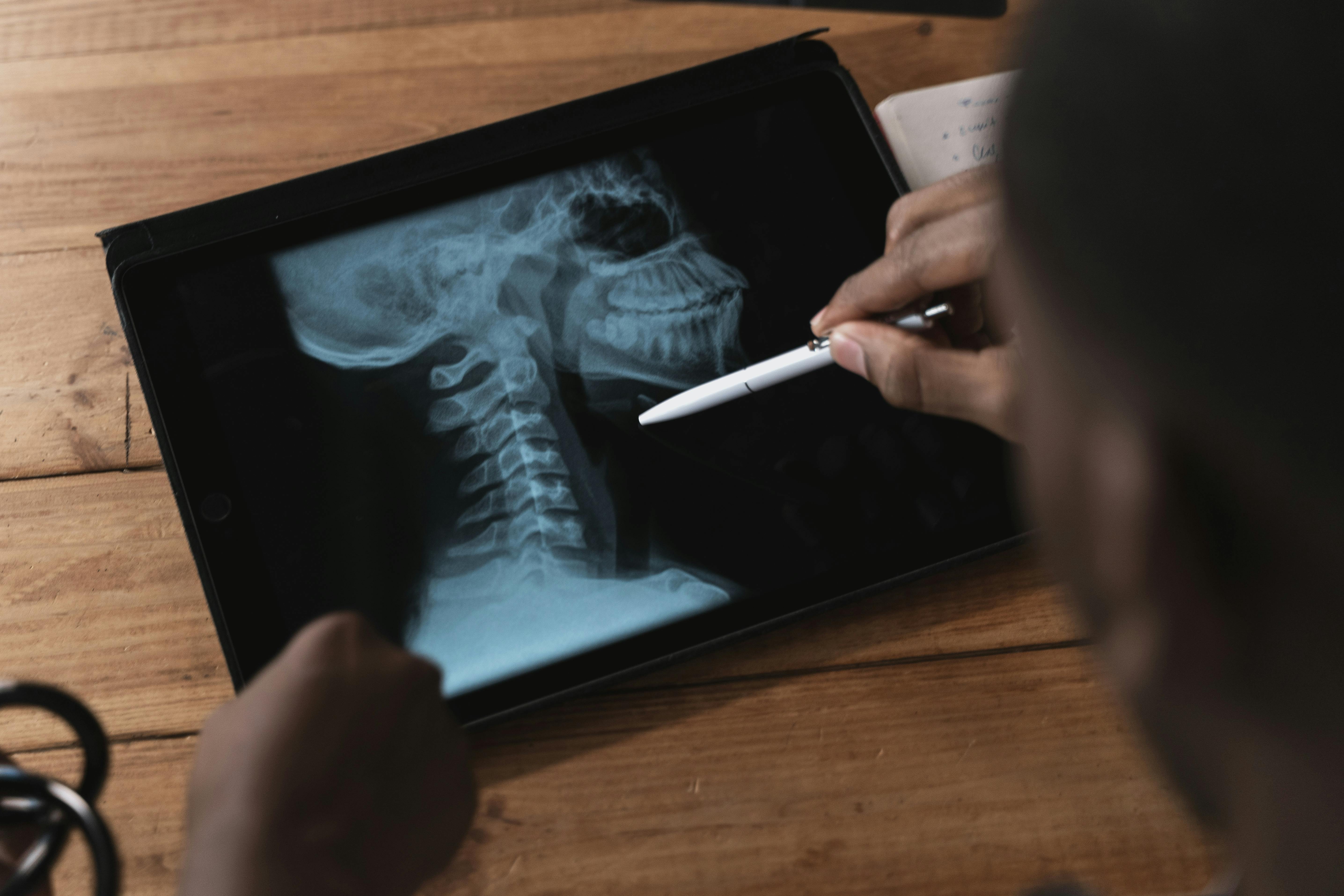
Plusieurs modalités d'imagerie permettent d'explorer la jonction cranio-cervicale. Les radiographies statiques (clichés en position debout ou assise, selon le protocole) sont au cœur des méthodes NUCCA, Blair et Atlas Orthogonal : elles servent à mesurer le désalignement de l'atlas et à calculer le vecteur de correction précis avant tout ajustement. L'IRM statique donne des informations sur les tissus mous et la moelle ; elle ne montre pas le positionnement osseux en charge. Pour évaluer l'instabilité en mouvement — par exemple une laxité ligamentaire qui ne se voit qu'en flexion, extension ou inclinaison — on peut recourir à des examens dynamiques. Le DMX (Digital Motion X-ray, ou radiographie dynamique en mouvement) en est un exemple : il enregistre une séquence de rayons X pendant que la personne bouge (flexion, extension, inclinaison latérale), en position debout et en charge. Cela permet d'observer le comportement de la colonne cervicale haute lors du mouvement et de repérer des anomalies de mobilité qui pourraient refléter une instabilité. D'autres options comprennent l'IRM dynamique ou le CBCT/CT dynamique, selon les protocoles et la disponibilité. Le choix des examens dépend du tableau clinique et de la question posée (désalignement à corriger par NUCCA/Blair/Atlas Orthogonal vs instabilité structurelle à faire investiguer en milieu médical).
Several imaging modalities can be used to evaluate the craniocervical junction. Static X-rays (films taken in standing or seated position, depending on the protocol) are at the core of NUCCA, Blair, and Atlas Orthogonal methods: they are used to measure atlas misalignment and to calculate the precise correction vector before any adjustment. Static MRI provides information on soft tissues and the cord; it does not show bony positioning under load. To assess instability in motion—for example, ligamentous laxity that only appears in flexion, extension, or lateral bending—dynamic imaging may be used. DMX (Digital Motion X-ray) is one example: it records a sequence of X-ray images while the person moves (flexion, extension, lateral bending), in a weight-bearing standing position. This allows observation of how the upper cervical spine behaves during movement and can reveal mobility abnormalities that may reflect instability. Other options include dynamic MRI or dynamic CBCT/CT, depending on protocols and availability. The choice of imaging depends on the clinical picture and the question being asked (misalignment to correct via NUCCA/Blair/Atlas Orthogonal vs structural instability to be worked up in a medical setting).
Pour corriger ce qui crée les symptômes et ce qui est à l'origine du désalignement (traumatisme, posture, etc.), les techniques upper cervical comme NUCCA, Blair et Atlas Orthogonal s'appuient nécessairement sur des radiographies. Sans mesure radiographique de la position de l'atlas par rapport au crâne et à l'axis, il est impossible d'appliquer ces méthodes de façon précise : l'ajustement est calculé à partir des angles et des déplacements mesurés sur les clichés. Chaque technique utilise ses propres incidences et son protocole d'analyse (par exemple analyse mathématique du désalignement, mesure jusqu'au 1/100e de degré dans certains protocoles). Les radiographies permettent donc à la fois de confirmer la présence et le type de désalignement, d'exclure les contre-indications, et de déterminer la correction à apporter. Au Centre Kiro Spécifik, lorsque des radiographies de la jonction cranio-cervicale sont indiquées, nous les utilisons dans le cadre du protocole NUCCA pour quantifier le désalignement et guider la correction.
To correct what is causing the symptoms and what led to the misalignment (trauma, posture, etc.), upper cervical techniques such as NUCCA, Blair, and Atlas Orthogonal necessarily rely on X-rays. Without a radiographic measurement of the position of the atlas relative to the skull and the axis, it is not possible to apply these methods precisely: the adjustment is calculated from the angles and displacements measured on the films. Each technique uses its own views and analysis protocol (e.g., mathematical analysis of misalignment, measurement down to 1/100th of a degree in some protocols). X-rays therefore make it possible to confirm the presence and type of misalignment, rule out contraindications, and determine the correction to be applied. At Centre Kiro Spécifik, when X-rays of the craniocervical junction are indicated, we use them within the NUCCA protocol to quantify misalignment and guide the correction.
Nous priorisons une trajectoire cohérente et sécuritaire. Pas de promesses, pas d'approche « miracle ». Nous offrons : un dépistage des drapeaux rouges et une orientation vers le médecin ou l'urgence lorsque c'est indiqué ; une anamnèse et un examen clinique structurés de la région tête-cou ; une analyse radiographique de la jonction cranio-cervicale lorsque des radiographies sont jugées appropriées, afin de quantifier le désalignement de l'atlas ; et, si un désalignement est présent et que les soins chiropratiques sont indiqués, une correction NUCCA — une technique douce, précise, sans torsion ni craquement, ciblant spécifiquement l'atlas et la jonction occiput-atlas-axis. L'expertise DCCJP (Diplôme de certification en chiropratique des soins de la jonction cranio-cervicale) soutient un raisonnement clinique prudent et une communication claire avec le milieu médical lorsque nécessaire.
We prioritize a coherent and safe trajectory. No promises, no "miracle" approach. We offer: screening for red flags and referral to a physician or emergency care when indicated; a structured history and clinical examination of the head-neck region; radiographic analysis of the craniocervical junction when X-rays are deemed appropriate, to quantify atlas misalignment; and, when misalignment is present and chiropractic care is indicated, NUCCA correction—a gentle, precise technique without twisting or cracking, specifically targeting the atlas and the occiput-atlas-axis junction. DCCJP (Diplomate in Craniocervical Junction Procedures) expertise supports prudent clinical reasoning and clear communication with the medical community when needed.
Si vous présentez des symptômes d'alerte, une évaluation médicale rapide est prioritaire. Consultez sans délai (médecin ou urgence) si vous avez : faiblesse importante ou progressive, perte d'équilibre majeure, chutes inexpliquées, trouble de la parole ou de la déglutition, vision double persistante, perte de conscience, engourdissement important, symptômes neurologiques nouveaux ou qui se détériorent, douleur cervicale sévère après un trauma, ou douleur associée à des signes neurologiques. Dans ces cas, les soins chiropratiques ne doivent pas retarder le bilan médical.
If you have warning symptoms, rapid medical evaluation is a priority. See a physician or go to the emergency room without delay if you have: significant or progressive weakness, major balance loss, unexplained falls, speech or swallowing difficulties, persistent double vision, loss of consciousness, significant numbness, new or worsening neurological symptoms, severe neck pain after trauma, or pain associated with neurological signs. In these cases, chiropractic care must not delay medical workup.
Si vous avez des symptômes que vous ou d'autres ont attribués à une « instabilité cranio-cervicale » et que vous souhaitez une évaluation rigoureuse de la jonction tête-cou, nous vous invitons à prendre rendez-vous pour une consultation initiale. Nous pourrons vous dire si un désalignement de l'atlas est présent et si nous pouvons vous aider, ou vous orienter vers la prochaine étape appropriée.
If you have symptoms that you or others have attributed to "cranio-cervical instability" and you want a rigorous evaluation of the head-neck junction, we invite you to book an initial consultation. We can tell you whether an atlas misalignment is present and whether we can help you, or direct you to the appropriate next step.
Commencez par une consultation initiale de 10 minutesStart with a 10-minute initial consultation